“Hajar Amithe Chhṛāno Je Āmi”
I You have bound yourself within yourself,
In a thousand of your own twists—
The self that is scattered among a thousand selves,
How will you ever know it?
Whatever you catch in a flash of light
Is only a fragment—
Wherever and however many wounds pile up,
I am all of those wounds.
Graduating every single moment, the self that is a corpse every single moment—
The soil of that self breaks its own chest and raises
A pulsing alluvial silt.
Into that self, the waters of the Jahnavi raise waves
Of a thousand selves—
On paths and bypaths, in village markets,
Alin is that self, a poet.
In this endless world of birth and death, I stand alone, amidst a multitude of selves. Out of the night’s hesitation is born a new self—a self that knows no fatigue, no desire, save for forging its own intimate relation with itself, wandering endlessly in search of that very self.
Within me lie the sorrows of disparate, shifting selves—sorrows that offer no palliative, yet this very “not-self” acts as its own palliative. Facing one another, the continuous search for a different self unfolds, and with the passage of time, erasing the darkness in a different transcendence, moving forward toward an expansive life. Yet, is this journey of the self merely our own solitary journey? Sitting beside a lonely wound, it feels like the intent of the dark; in truth, this journey is the journey of the whole, a journey of faith in the new. This journey of the self belongs to no personal ego. But do we truly find transcendence in this journey? All the lamentation of life remains awake beside that wound; is it merely the ennui of a personal self? Such a question renders the self even more personal, and then, little by little, the truth of death emerges momentarily—a truth in which we seem to find no expansion of life. Standing before the mind, facing the self, one feels compelled to ask: Who, then, is this ‘I’? It is as if someone holds that current, like a detachment from one’s own self, and amid this, the truth of the self drifts along, refusing to be singled out. I am entwined in everything; the current of the self is embedded within all creation. Sometimes, the mind wishes to turn away from that current, creating an inner tension, yet simultaneously it discovers the faith of liberation within the rhythm of life, momentarily detaching itself from everything. Finding a distinct path of liberation within consciousness, catching a fleeting, minimal glimpse of different selves within the self, one feels this is a singular time—yet so faint that it remains trapped in the subconscious. Within the surrounding emptiness, the mind seeks the true-formed self: sometimes reaching the crowd from solitude, sometimes reaching solitude through the crowd, drifting back and forth across shores. Is this coming-and-going merely that of a personal self, or is it the self of the universe? Such a question is only natural to arise, because this self is not just a self; this self is the burden of a collective self, and its desire for fulfillment does not belong to the personal ego. Thus, one feels inclined to say: “You gave me the burden, hence I am a lonely herdsman / You gave me the burden, hence I am such a morning and evening.” We know that this solitude is indistinguishable from total consciousness; rather, that very consciousness is the sole vessel of creation.
We experience this current of the grand creation of the self, watching the transcendence of truth break apart under the veils of the self.
The transcendence of the self is this very poem—a lingering gaze toward a different current embedded in the consciousness of creation. This experience is the darkness of all creation, and this dark self-darkness is also a path to knowing oneself anew. Such a path of knowing is not entirely unprecedented in Bengali poetry; in the poem “Māti,” “This earth is my earth too—how shall I prove that to everyone today!” How shall I say, “Beside my own corpse / lay the crescent moon,” yet “it was with the caress of my own hands that this gandharaj blossomed”? Or we might recall the completeness of the self captured in a different consciousness within Shankha Ghosh’s “Yabajjiban”: where you think, “Seeing me from the other side, I am like you / melting into emptiness,” and “somewhere, an age-old pull flows like the Phalgu,” but “who can ever comprehend that, letter by letter,” because “how else would anyone know who live outside prisons today / carrying a life sentence.” All this we have known from “Bahuswar stabda paṛe āche” down to the present day. But do we easily encounter the reading experience of a poem where the shifting conflict between this coming-and-going manifests as an ongoing current of creation?
II
On the other hand, when a creator continuously reinvents creation within themselves, they cannot express themselves solely under the identity of the collective. Some might question: Is the manifestation of the collective truly vital along the path of a creator’s grand creation, or is it only natural that they cast aside their personal self to articulate the collective “I”? Does this notion sometimes make us feel that a special expansion is merely the conceit of self-satisfaction? Put simply, it is hardly a fault for poetry to carry that self-conceit; rather, its absence would be unnatural, because the society and humanity whose realization a poet seeks through the experiential depths of consciousness are things we naturally encounter there. When a poet writes, stepping beyond personalized timelines, we are bound to find the collective “I” within that poetry. Perhaps if we try to pinpoint a specific society, or if we look for a distinct personal identity within the universality of the subject matter, we would be mistaken. For when a poet composes a poem, it transforms into a journey through a different epoch—a path where we may discover new directions, yet never a specific, predetermined route. We know that poetry cannot truly be touched unless one steps beyond the personalized self.
Nearly fifty years ago, responding to an invitation by Paul Engle, Shankha Ghosh traveled to Iowa City, where twenty-seven writers from various countries spent a few close months together. In the midst of that respite, the poet formed the habit of keeping a journal, and it was there one day that he wrote of a different identity. He wrote: “Does a person abroad walk around solely with their personal identity?” This question arose from his experiences right there. If we accept this as truth—that a person retains their identity even in the subconscious—perhaps there is little to object to. But “do not their words, their behavior, their radiation, at every single moment, push the individual aside and bring their homeland to the forefront?” We know that subsequently, “in the midst of one’s country, your identity may not be merely personal, but outside your country you carry the very map of your homeland; that is your responsibility, for there you are never merely personal.”
If we then read that poem of his alongside these thoughts, we begin to comprehend the vastness of what we call the “I,” where he says: “Every stumble of yours will be marked as a currency of your country itself, your minor glory will become some glory of the nation—knowing this alone, must one live out days within the self?” That day, the poet had to explain to the young American novelist William Kio: “There may have been a touch of harshness in what you said, but it was not unjust.”
This idea of being “a currency of the country,” invoked while speaking of creation and the creator, applies not just to a nation, but equally to poetry and to the poet. The “I” through which a creation comes to life never remains personal; it becomes the vessel of the universal self—a vessel that, conversely, serves as the poet’s path of constant transcendence. For those of us who have felt a deep resonance with his poetry for a long time, such thoughts arise intimately. It feels like no alien notion; were not those unconscious shocks of the early days of youth what became his Dinguli Ratguli? Or were they written in some trance—those introspective, human faces that truly teach us to think, yet where a certain melancholy keeps us at a distance from that experience? One feels tempted to ask: Is this then a protest, somewhere merging our delusions and corrupted passions where we sense a convergence of Rabindranath and the subsequent stream? It feels as though Bishnu Dey and Jibananda Das are not far away. Viewed from the surface, one might not say so, yet tradition is such an entity that, when delved into deeply, that self-confidence remains embedded in our daily lives. This is that unconscious shock flowing inwardly through Bengali poetry, transforming into a language of protest and a pathway of transcendence. Is this precisely where we feel a oneness with his poetry today? Does protest and experience alone constitute the sole identity of that poetry for us?
One day, in the course of conversation, speaking about the genesis of his poetry, Shankha Ghosh remarked: “I do not subscribe to any single path or method regarding the birth of poetry. There are moments of birth of various kinds, across various levels. Often, good poetry can be born from those epiphanies of seeing that are readily apparent, yet of which I am not always consciously aware.” Within the act of seeing, the wounds of time accumulate, and this mind carries the burden of those scars. Though invisible from the outside, we know that “within man, there is yet another man, and another, and another.” Bearing this, man arrives at the very edge of life, seeking the transcendence of that human essence which resists simple categorization. If we ever attempt to locate the “I” of poetry solely within those fragmented individual selves, we fall into error. Yet, we must also remember that it is precisely within those fragmented selves that the true essence of poetry manifests itself.
However, this is not all. If we read Shankha Ghosh’s poetry a bit more deeply, we notice how his verse begins in a light atmosphere and drifts toward a different, weightier subject. It feels as though the constant shock of awakening embedded within his writing spills over into the daily ups and downs of our lives. Is this sprawling across multiple levels from the shocks of the unconscious mind, or does it feel this way simply because no such habit has yet formed within our unfamiliar, hidden selves? Some might argue that a vast phase of the past has endowed his poetry with a distinct inner capability. The rhythm of tradition and contemporaneity that he discovered in his early youth remains the greatest truth for his life even today, drawing him closer to humanity through the cultivation of the mind, deep within the arteries of love. This pull that we feel in his poetry is love itself; love is supreme—a truth that Shankha himself once affirmed in support of that universal self. Dinguli Ratguli was his preparatory phase; though it may seem somewhat sluggish at times, this very sluggishness would one day become the shelter of a personal self for Shankha Ghosh, as we realize when looking at his corpus as a whole. Yet, it is comforting to think that this never became the sole identity of his poetry.
The depth of his love for “Yamunabati” to “Mala or Poonam” can be gauged from the inner warmth of his poetry. At such moments, we are perhaps reminded of certain aspects of his own life, where—alone in the melancholy of a failure—he finds himself unable to touch the hesitation and vulnerability of others’ minds. When he thinks of the youth of those lands, his own heart grows heavy with melancholy, for is this failure or despair “what Tagore envisioned for the shaping of man? Is this its outcome?” When we know that Tagore transcends being a mere proper noun to become the identity of an entire form of life, can this truly be the manifestation of that form? And so, sitting beside one such wound, Shankha Ghosh wrote, from Ātmaghāt to “Our country still has no…”—a continuous rebirth of words begins to take place. And within those words, we encounter the fragmented realities of the land, the rhythm of our solidarity, as poems of distinct visions begin to take shape:
The heart yearns to claw into the void,
In the dance of destructive genius, finger against finger
Cries out in agony.
Beneath the water or atop the glacial peaks,
Who is left to explain anything to whom?
Meaningless words shriek in pain, and you, therefore,
Listen in stunned silence:
Our country still has no—
Our country still has no—
Our country still has no mother tongue—
Not yet.
Often, we speak of our lives carrying tradition along with us, yet in the sway of time, we forget those very things over the most trivial matters. Even in his very brief poems of the times, Shankha Ghosh meticulously preserves that distinctness and that forthright confrontation.
It is not merely social or personalized timelines that trouble the poet; he grows deeply restless over larger, broader themes as well. Yet, the current of his deliberation is so profound that, without surrendering to time or isolating himself, he guides his self toward a different path of transcendence. This repeated quest to carve out a distinct path for oneself within the flow of time constitutes the poetic tradition of his liberation. However, along these paths of transcendence, there emerge the transient arrogances of society’s corrupted faces, where miles upon miles of superficial peace and welfare prevail. It is then that he wishes to shatter the wall of his deliberate restraint, step out into the open, and stand at the very front to declare:
With a knife held high against the belly,
Naturally, I roam about with newfound freedom now—
Everything is peaceful now, everything is fine.
Liquid fire fills the stomach,
If you want me to confess just that, I will—
Truth has finally turned grandiose.
This is the liquid fire of Shankha Ghosh’s poetry—floating upon the waters of his transcendence. This is the truth of his poetry, standing upon which we too become the dust of his path and often attain the means of liberation. From the temporary clamor, the language of his poetry draws an aura of distinctiveness:
We have come today, at early dawn, to this garden of healing.
The city sheds its bark; upon the pith, the lifeline
Illuminates all the fine body-hairs—a green darkness;
Once again, at this misty dawn, we have come to the garden of healing.
Raising their heads just a bit from the earth, the tomal and piyal saplings
Still gaze with childhood in this enclosed garden—
Soft chips of stone are filled with a juicy radiance;
The gardener knows well what kind of caress each can bestow—
They are in healing, intending to give of their healing’s abundance,
We have all come at the frosty dawn to this garden of healing.
This too is yet another mode of expression in his poetry, where a slow, deliberate cadence blends with the flowing current of eternal truth. Yet, within this writing, some might perceive a kind of trance-like state. But we know this trance resides merely in the movement, for Shankha Ghosh’s poetry has no rigid pre-planning. Rather, a line arrives unexpectedly, fusing with the glow of long-cherished thoughts and enduring experiences. When Shankha himself remarks that this state perhaps does not stem from any deliberate, singular thought of that exact moment, a question naturally arises: Does no temporary shock, then, inspire his writing? Or does it, reaching deeper, simply wait for its own appointed time to become poetry? When a line arrives suddenly from some impact, it is pursued by a subterranean stream rising from the depths of the mind. Memory joins it to a web of a different time lingering in the subconscious—is it thus that the momentary light of his poetry falls upon its shadowy path? But if so, is the poet forming such a concept about himself? For as he once said, “Unless one is vigilant at every moment, there is a strong likelihood of formulating any number of foolish notions about oneself.” If so, then what? Shall we then “wake up thereafter in some misty dawn,” because “this self is then no longer I, but like some newborn child of the earth, carrying liberation in eternal absorption, opening its eyes to gaze upon you through the primal hour”?
Reading this poem, one might think that external shocks stand out vividly, yet what that captures is not the distinctiveness of the poetry, but rather the external face of time. The fragmented image is not its sole foundation, for the poem itself becomes a stratum of feeling that we can no longer blend into some alternate, temporary shift. Yet, in terms of truth, it cannot be seen as entirely detached from time; poetry sometimes transcends time precisely because we become one with that very time.
Did the poet’s conception of poetry undergo a transformation by middle age? Is that what we tend to think today? Because in quite a few of his poems we find the bondage of liberation—a different current altogether. Yet, to think this marks a sudden transformation would be mistaken. Speaking on this subject once, he remarked, “I do not think any fundamental change has occurred. Some concepts that were perhaps vague and obscure earlier may have become sharper or clearer by now.” Thus, for him, the true essence of poetry is experiencing that very time which reveals the truth, and this becomes possible only when one’s entire life is entwined within some vessel of truth. Confronted by this truth, he hears “the sound of oars within the ribs,” as if the entire cycle of the water-current has suddenly ended.
Here, some raise the question: It feels like “a canopy over a corpse.” Yet, twenty-four years later, he would write: “Water itself has turned to stone,” as if “with our indifferent deafness,” truth and falsehood have sat together to be wed “on a single seat, in a room stretching from earth to sky.” Reading the poems belonging to this phase, one might feel the lingering sting of a temporary event imprinted upon the verse. Yet, the deeper we move into the inner, conflicting emotions of those poems, the more we realize that their source is shifting away from what was initially assumed. Instead, there emerges the transcendence of a realization born from the impact of our own experiences. The truth of poetry thus ceases to be any special, contrived arrangement; for when someone reads poetry, the intrinsic artistic grace of the verse is not merely the flow of a conscious mind.
When we think along these lines, the conflicting temporary shocks of events cannot dull the poetry. At that very moment, the sharp points of multiple distinct perceptions begin to revolve in the depths of the reader’s mind. A different awareness is born, and the entire poem transforms into a clear, intense utterance of a void stepping out of that epoch. Some consider this clear articulation to be merely a fleeting hint within his poetry. But is that so? Can a poet’s work truly be defined in such a manner? In one sense, this articulate clarity is indeed a property of his poetry, but it is not the only one. For if we look back at his entire corpus, we can easily discern the multi-voiced cadence of our everyday lives woven seamlessly into his verse. This consciousness is as deep and natural as water within his poetry, which is why he can so effortlessly say, “I shall become as simple as water,” or evoke “the moisture of water” and “the heavy moisture of days and nights.”
When the “latent shadow of the netherworld” emerges to confront its truth, he asks: “Does water understand any of your pain? If so, why—why would you go to the water, leaving behind the intimate moisture of closeness?” And when, diving still deeper, the question arises: “Does water bring pain to your chest? If so, why—why do you wish to leave behind the heavy moisture of days and nights?”—we realize that this is not an experience synthesized merely by the poet’s senses. Rather, a different kind of emptiness itself becomes the cultivation of this poetry, making us understand how the opening days of human life tremble under the impact of varying, shifting shocks.
III
When a poet declares, “To speak the truth is the true task of poetry,” it is hardly difficult to comprehend what he seeks to define as the very nature of poetry throughout his entire poetic journey. For truth alone imparts the touch of life to verse. This forms a distinct dimension of his artistic philosophy; yet when he states, “To remain awake is the true dharma,” one begins to ponder how the poet sustains his wakefulness within his verse. In a sense, poetry strives to become for him the ideological faith of the universal self—the moisture of transcendence along the path of an entire lifetime, for poetry alone possesses the capacity to shield him from every falsehood, every hypocrisy, and every cacophony. But in harboring such thoughts, are we inadvertently attempting to blend Mallarmé’s pure self-apprehension regarding poetry into his work?
Yet, when someone remarks that language is inadequate, that we can never quite touch its zenith—when this lament strikes a poet’s consciousness, do the words of poetry dissolve our awareness into symbolic concepts? Or might we consider this as a power-house capable of generating new forms for poetry? Can the circle of an entire poem not unfailingly serve as the inspiration for our life’s transcendence? To those who have immersed themselves in Shankha Ghosh’s poetry, this realization can sound like a healing balm. It may seem as though poetry itself is an uncertain current: how can we expect the exact same accumulation of experience while traversing a poem? Rather, it is entirely natural that diverse experiences draw poetry ever closer to our actual lives, for the poet himself discovers this at times, prompting him to say that entering poetry requires waiting for a distinct “anticipation of silence.” Does this gradually lead to liberation? “Thus it shall be, human beings sewn together in rows, waiting.” And this waiting is not some dissolution into the subconscious; it is a meditation on connection.
One day, speaking of how a poem comes into being, he remarked: “In truth, for me, writing a poem is essentially preparing oneself just a little bit more.” When a poet speaks thus, we must understand that poetry strives to become the eternal light of wakefulness. This is his all-encompassing morning sky, a truth he articulated toward the end of his days in a poem: “Waking up, taking everything, bringing everything, I stand here and declare: This is all I am.” This is the enduring truth of the yellow bird’s solitude.
Yet, there was a time when the poet himself wrestled with deep inner conflicts regarding his own poetry, forcing him to stay away from writing for long stretches during his formative years. His mind simply refused to reconcile with the prevailing trends of contemporary Bengali poetry at the time; he had to detach himself from the manufactured verse of that era for a prolonged period. He had to pause—not because any time is inherently unfavorable for writing, but to truly intertwine oneself with the essence of poetry so that the verse could genuinely emerge.
Eventually, in his daily life and movements, the everyday speech of ordinary people drew him back to poetry, for he felt that these very words had drawn closest to his poetic voice. Thus, one day, those simple, unadorned words transformed into something resembling the precious, flashing facets of a gemstone, each pressing against the other to reach the peak of a flame. Perhaps they arose this very moment from direct perception; yet keeping the tendencies of the subconscious awake is not its sole task. Stepping beyond spoken vernacular, the verse plunges into the vessel of the infinite, and the poet discovers that very language through the total conviction of his life.
With faith in humanity, with moisture, with love, the emotions of the Bengali poetry reader are intimately entwined. When restraint and the harmony of protest within the expansion of tradition form the pledge of his poetic life, strength flows back into the hearts of Bengali readers—and surely, this too is a way of living within poetry. Shankha Ghosh’s poetry ultimately transforms into poetry of human transcendence, carrying Bengali poetry forward into a fresh, distinct idiom.
The genesis of the newborn (Nabajatak) marked a path of moving beyond Tagore, for the quest for a new path was indeed the need of the hour for Bengali poetry under the shadow of crisis. Approaching too closely, some sought to pull away from his circle of thought, cultivating a tendency of outright denial. Yet, in trying to detach oneself from tradition, the sensibility of Bengali poetry only grew deeper. Just as naturally, however, a swagger of intellectual pride attached itself to the form of that poetry. In this phase of verse, we witnessed a different current: poetry no longer wished to reach the reader; instead, tactical ostentation returned to the work, and the jubilation of intellect overshadowed language. Right at this juncture, Bengali poetry became severed from its true identity.
Yet this does not imply that poetic form alone became the perpetual habit of verse. Just as the ambition to become something new kept Bengali poetry from the habit of simple cadence, it also refused to detach itself from the life-cosmetics of a different awareness. Modern poetry did not seem as precious to some as it was alluring; one reason for this was that most modern poets still sought refuge in lyrical modes, whereas a successful transcendence of Tagore is possible solely through the use of prosaic cadence in poetry—through the everyday rhythms of speech.
And thereby, the current of Bengali poetry would be liberated from the deadening effect of sluggishness. It is not that some did not attempt the habit of speaking simply, but occasionally, beneath the guise of that simplicity, the threat of a fracture crept into the verse. If we glance backward, we find that the current of Bengali poetry was seeking a different path of modern taste, striving to free itself from Tagore’s all-consuming embrace.
#Yet the question may arise: Can the habit of speaking simply truly become the language of poetry? This dilemma troubled the poet as well; just as his conviction granted him the inspiration to walk that path, we must remember that “when the foundation changes, the configuration changes too.” And right here, spoken vernacular advances toward poetry donning a new form. Does poetry, then, possess no language of its own? Shankha Ghosh remarked: “If there is no difference between spoken language and the language of poetry, what is the need to write poetry? And if spoken language and poetic language were entirely different, what would be the point of writing poetry either? Language is forged precisely in the tension between the likeness and unlikeness of the two.”
Did this very language become the poet’s own distinct idiom? Yet this did not remain his sole expression of modern taste, for into that language the poet wove a different order of experience. Stripping language of cosmetic explosions, he liberated poetry from the confines of rigid form, embracing vernacular speech within the cords of realization so that it ceased to remain mere spoken words, transforming instead into the flowing current of life set to melody. And here, that language is “new”—not merely because it is bound in meter, but because the flow of another life within life captures our immediate present. When it receives permission to move forward, it gains the inspiration to march along the path of truth.
Does life and poetry, then, no longer remain on the same plane? Do they diverge along the path of their journey? Faced with such questions, we might ask: Is this the resolution of that dilemma? Is this the open, harmonious synthesis between life, human existence, and spoken words? Naturally so. Between the “face turned outward” and the “face turned inward,” our human existence flickers—our worldly living encompasses both. “And between these two, an incessant conflict rages. Out of this conflict arises a third entity. That in turn becomes the primary, giving rise to an opposing secondary, and once again a third is born. Thus life, or poetry, continues to unfold.” Fusing with this artistic life, the poet’s daily inclination becomes the very medium of expression.
Just as Jibanananda Das emerged, distancing himself from the clamor of the intellect around him, finding the discovery of a different world through the moisture of awareness—a synthesis of a different language serving as the primary hallmark of his writing. This concept of synthesis arrived by way of Tagore. Six years before his death, speaking to Dhurjati Prasad Mukhopadhyay about the book of poems Shesh Saptak, the question arose: By what rule does prose rise to the level of poetry? Is Jibanananda’s poetry, then, that poetry which employs the language of prose? Such a question naturally arises. A simple answer would be: in one sense, yes. But is this the sole characteristic of his verse? Then what? Jibanananda’s poetry approaches prose very closely yet steps back, leaning upon the very language of poetry as if the vital breath of verse has fused with his life-realization—where language is no longer just language, but transforms into #.
If we look back at his corpus, we find an underlying restlessness in that tongue, and this very restlessness becomes the language of his poetry. Yet, have we truly been able to draw close enough to his poetry where the desire for fracture resides? Carrying such a desire for rupture, Shankha Ghosh stepped back, even while remaining close to Jibanananda, aspiring toward a different kind of synthesis. In a sense, the initiation of that synthesis occurred within Jibanananda’s world, marking the ultimate transcendence of Shankha Ghosh’s poetry.
“Afterwards, all the way, without uttering a single word / we keep walking, keep walking…”
“Such a sky will be like your eyes—wordless, mute.”
“Now a human heart sleeps, its name written in water.”
“O poet, do not go, do not go / the sky will grow dense with the white flowers of pain, the soul will fill with leisure.”
“Yet love arrives, yet the hint of life weeps.”
“And I too, like one blind, stretch out both hands to that meeting / merging like waves.”
And written much later: “Today, after all this day, sleep eludes our eyes.”
The traces of tradition imprinted upon these poems are unmistakable in their words and imagery. “From my thousand selves, more and more selves awaken / I am the century, I am the continent without beginning or end.” “Today within death, there is not a trace of death anywhere.” Like “the scar of a star in the heart,” or “the reflection of light upon green glass, like memory.”
Then “do I alone forget?” Have we ventured “closer to the heart?” “We slipped away into the bushes like jackals when the time was right.” “Returning from opposite ends, we met in the Mediterranean.”
We are reminded of the crucial role played by the expansion and reception of the tradition of Bengali poetry. We recall Jibanananda, where the stream of poetry amidst temporary, fragmented epochs reads like a history of unfulfillment. Yet this concept remains unfinished in the annals of Bengali literature to this day, and Shankha Ghosh positioned himself at the forefront in search of a different path, serving as the living symbol of Bengali poetry’s tradition. Within the unfathomable depths of existence, that transcendence remains a poem—breathing with a moisture distinct from memory, stretching from Dinguli O Ratguli and Nihito Patalchhaya down to Bahuswar Stabda Paṛe Āche. If we look back, we encounter that very same, unbroken current of words, echoing across time.
As if the longing to journey from this “I” to that “I” is filled with “emptiness”—that very “darkness” of the star whose echo we once heard from Tagore down to Jibanananda’s poetry, where that same word takes on a vastly different meaning in his verse. As if “Leaving me at the edge of slumber, leaning into the void / where does the deep night wander in the tumult of youth?” Yet not in this sense alone; within the cultivation of poetic language, he deepened a distinct tradition, bridging the vast expanse from Tagore to Jibanananda: the “water-touch” of Nabajatak, “Startled, startled faces, toward whom shall I look any more, / and thus I accept you as the ultimate sanctuary.” And thus, at times, “upon the wave-less, still, flat waters, we touch the dense, profound water-touch once again.”
When the poet successfully isolates this “I” from all cacophony, allowing “the faintest words to receive the touch of a moment” through our everyday perception, merging this philosophy of life into a deeper current, poetry transforms into that very realization of life. Moving away from the ostentatious swagger of conventional verse, the grandeur of a dialogue between the ordinary “I” and the self becomes the true language of his poetry. Yet we must not forget that he did not merely infuse that language with distinctiveness; he entwined it inextricably with life itself. Even amidst the transient turbulence of a poetic life, he was at times compelled to say: “It brings shame to think that even today you suffer from ingratitude,” because “the way your hands tremble with fear while writing every single poem, for you too know that in this life there is neither beginning nor source, and that this is your very first poem.” And that very poem transforms into a fresh, transcendent translation of Bengali poetry.
Oplus_131072
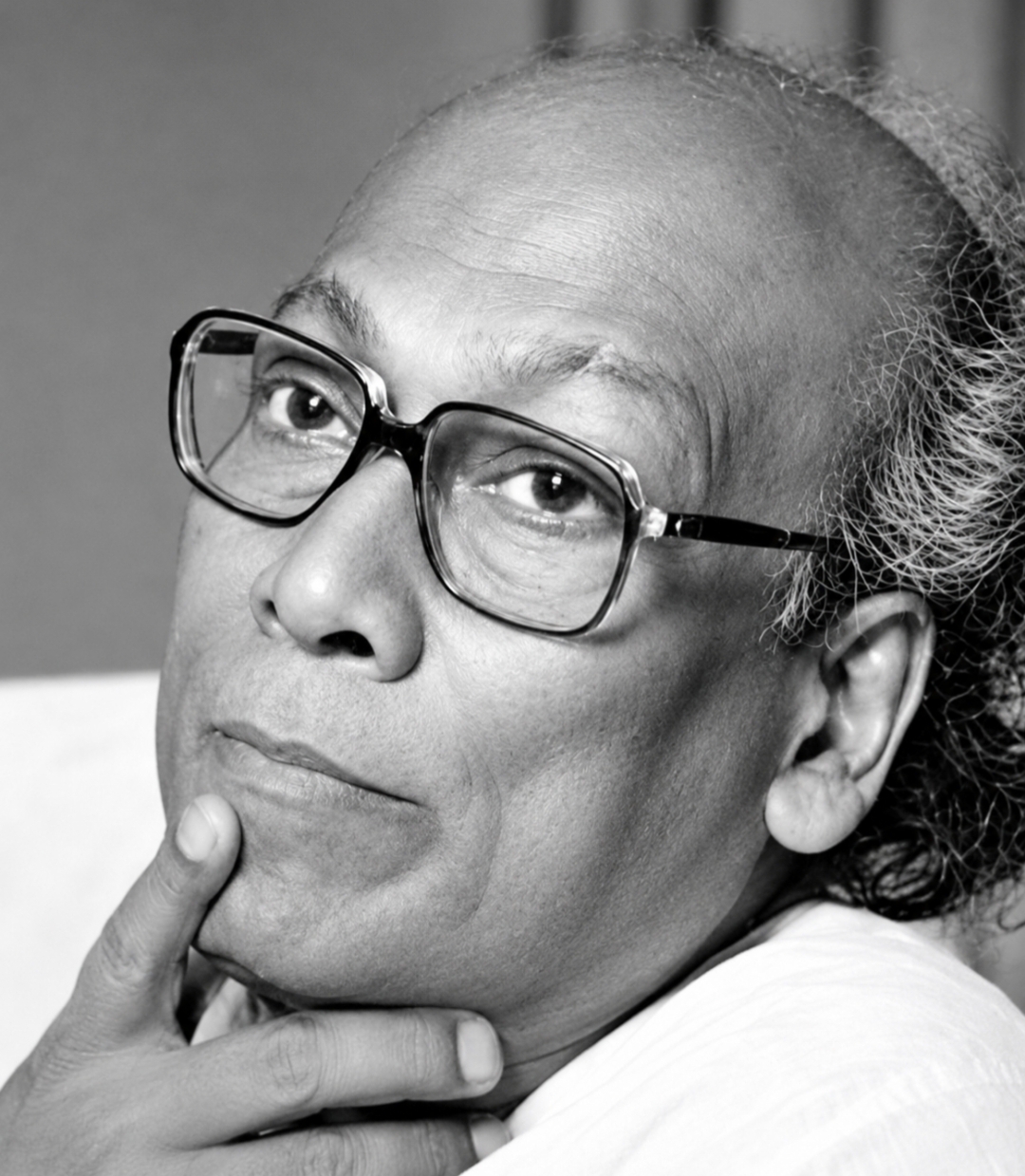
Shankha Ghosh (1932–2021)
Shankha Ghosh (5 February 1932 – 21 April 2021) was one of the most distinguished Bengali poets, literary critics, essayists, and scholars of modern India. Born in Chandpur, in present-day Bangladesh, he was particularly renowned for his profound understanding of Rabindranath Tagore. Often regarded as a significant poetic successor to Tagore and Jibanananda Das, Ghosh developed a distinctive literary voice marked by linguistic precision, moral depth, and a deep engagement with social and political realities.
His first poem, Dinguli Raatguli, appeared in the inaugural issue of the literary magazine Krittibas in 1953, and his first poetry collection of the same title was published in 1956. He taught Bengali literature at several institutions, including Jadavpur University and Visva-Bharati University. His notable works include Baburer Prarthana, Mukh Dheke Jay Bigyapane, Urvashir Hasi, Gandharba Kavitaguchchha, and Ocampor Rabindranath.
He received the Sahitya Akademi Award (1977 and 1999), Rabindra Puraskar (1989), Saraswati Samman (1998), Desikottama (1999), Padma Bhushan (2011), and Jnanpith Award (2016), among other honours. His poetry and critical writings remain an enduring part of modern Bengali literary heritage.

