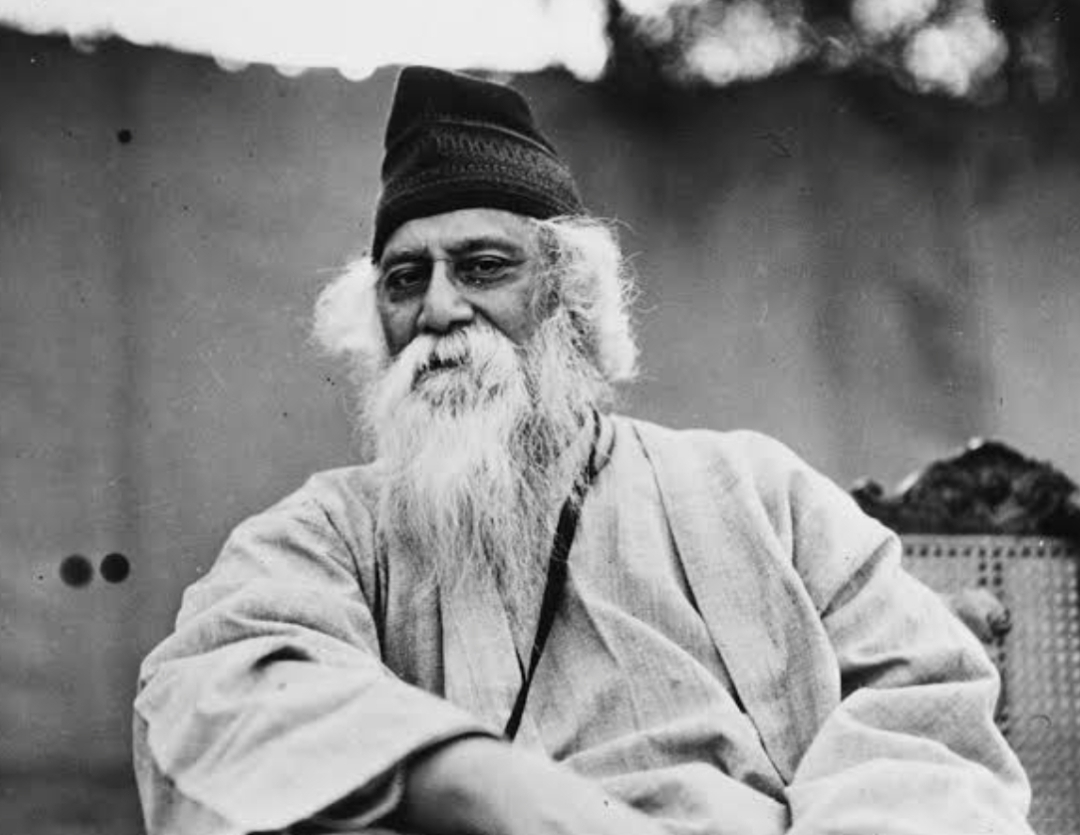
image of Rabindranath Tagore provided by author
When weaving Damini from Rabindranath’s novel Chaturanga into the fabric of life, he showed us how restless the sea was in the full moon of Falgun. How, taking the blow of the offering to her heart, Damini embraced the transmigration of the ego. Yet, was her desire truly fulfilled in that tide of love? Perhaps because we magnify her flow from one lifetime to the next, the picture of completeness has slipped away somewhere. It is as if her very death became a vision that granted greater value to the unseeing flow of existence.
I know some will say, did Damini herself wish to step away from the ocean of sorrow? Did she not yearn in her heart to salvage her life by the value of her time? Or did she wish to dissolve herself into the vast heart of nature within the skies of consciousness? And nature ceases to be mere nature then; does it not resonate within our hearts as the symbol of our mental ideal? Right here, that joyful full moon seems to become the sole pathway for her love.
Yet even primordial union carries a sorrow; the union that is external holds sorrow within it. It holds greed; as Rabindranath once noted in a letter, “The expansion of the outer is greed.” Through it, union remains incomplete, and sorrow fills it up. And when this sorrow becomes the assurance of living, the essence of a covering, the sole sign of love, does it not feel as though some other unwritten image of a wound is actually veering over the intimate moments of that life?
Such vague questions stir a sense of wonder within us. Do they not? Does it not cross our minds—how does the face of that intimate moment awaken? Why did the sorrow of the union between Damini and the ocean merge into one? What kind of face is it that keeps veiled the illusion of the life-circle, the starry happiness of all lived thoughts? Sometimes, our minds are disturbed by trivial interests amidst the grievances of the higher echelons. As though it alone has the sole right to fill the infinite void of time; when it considers life’s ample offering as a way to question itself, and a hint of return from that path, does it not feel as though it fails to recognize itself then? “When there is a veil, it is a distance of eternity. When the veil breaks, it is the balance of a single moment.” Is not this “oneness” also the initiation of distance—a total current of mental movement? Which brings the honor of a lightly spellbound life into the house of our survival! As if the creation of a time that “has been,” the profound musical darkness of solitude, the jolt of self-possession. In the novel Chaturanga, Damini said to Sribilas: “I was within a dream; I was only waiting for this single jolt.” But then? Was she “the awakening of the ocean, complete today within the heart of a flower,” the jolt that Damini took to her heart? She accepted the joy of life, which is why it felt to her, “The rising between that you and this you is merely a spell.” This spell came through her meditation, the path of liberation, the beauty of creation, and the experience of secret opulence. This spell will remain within her forever, another transmigration of this unity. I know some illusions will come every day, kneeling to ask for their offering, “This truth, unblemished, shall deny death.” In the seedbed of this earth, this very offering is illusion. It wants to leave something behind through Damini’s death, like the dawn of two words, like a shadow in the current of illusion—death that is the spell of the entire sun, beyond death, the expanse of a submerged heart. But this “ego” wants rest; it wants an identity of its own. And that “ego” finds no rest. Its sole dharma is merely to walk on. To want to surrender to itself. Rabindranath wrote, “Yet through this unbearable sorrow, a sudden breeze of joy began to blow through my mind from moment to moment”—even within this joy, he felt the strain of melancholy; a tune in which sorrow resonates in the stream of life. Because when we try to let go of what we hold close, looking at it from the perspective of loss, we feel pain. Yet if Rabindranath finds the path of liberation within this very pain, if that path is the path of wholeness, he feels a generous peace. Sorrow then no longer confronts us with the pain of restlessness. When we look at Damini through that sorrow, that message of peace takes possession of our minds. Do we not yearn for this peace in our daily ups and downs? Does the mind not wish then to frame that very leisure within the jeweled chambers of memory? It does, and because it does, we gaze into such expanses. It feels as though such a vessel keeps us alive. It feels like, “In whichever room you have kept me in this world, in that room I shall dwell, forgetting all sorrow.”
When will he come, bringing the “I,” and upon its seat, fragments of life will awaken into vivid images? The cycle of giving and taking will end then. Yet, knowing you will not end in this lifetime.
Here, it feels as though Rabindranath steps up to stand beside Damini. It is precisely for this reason that Damini never wanted to reveal her failure. If we think her final statement is proof of this, we might be mistaken. She believed she would somehow fulfill the perfection of that fullness, the completion of this union. And in this context, it is only natural that songs and poems by Rabindranath himself come to mind. This very arrival is the medium through which we reach him. Around the time she becomes Damini, a song from Gitimalya might cross our minds—how effortlessly Rabindranath surrenders all the pain of life to its ongoing flow, as though someone speaks in an infinite current, “Allow me to hold your feet,” sounding just like Damini’s own voice. Does it ever feel as though Rabindranath is still expressing this in various ways? If we do not overemphasize the fact of his death, if we do not think of Damini merely as the Damini of Chaturanga.
In the novel Chaturanga, words like “No matter how far I go, taking my heart and soul into your infinite” might feel upon Damini’s lips like a life-mantra. Just as Sachish, caught in a spell, could not understand Damini, and Sribilas, despite being extraordinary, could not break free from the spell—this pain certainly became a song on the path of her liberation, but perhaps she never witnessed the flow with her own life. Damini had said: “This pain is my secret opulence, it is my touchstone.” It feels as though our connection with Chaturanga is forged right here.
And this connection becomes the sole means of separation. How can a connection open the path to separation? Did any such path truly open up for Damini? A path that can erase past adjacencies, that alone can break the private shackles of life’s perception. It happens sometimes that certain external shackles of habit deceive the mind from within, cloaking the image of truth in the light of falsehood. Then the mind of loose, unanchored time accepts it as well. In this way, does the world-heart think that if the dust of Sribilas’s feet becomes the final savings of this life, if we regain the final embrace of the ocean—is this not true? It is the fold of my very own mind! It is the pledge of giving, the preparation to return oneself. It feels as though these subjective monuments of life easily roam about the upper chambers of the mind because the deity of that song sits there in astonishment. Is this too small a gift? He is the wonder of my unfamiliarity, the line of my path in the darkness. Along His paths, did not someone among us wish to say, “May what I received on the first day be what I find at the last”?
The current of the novel seems to want to blend our “I” and “you” onto the path of self-surrender—the path that leads to the secret opulence of Damini’s love. “This love is true, the gift of this birth.” Is there truly any path that, even as separation, embraces the “I”? Surely that path is the path of the “I” gazing upon itself! Surely Rabindranath has given us that hint, standing beside Damini. The path of the “I” begins precisely from that gaze of looking back. “This is an entirely new seeing. It is so new that it cannot be fully understood; only a sense of pain is felt.” Prior to her death, Damini said: to take her to the edge of the ocean from where she brought her pain, where there is no lack of life. We understand she wants to keep the “I” awake. This keeping-awake is not merely staying awake; it is also keeping open the door for the “I” to enter, so that this “I” may travel along that path. And one also feels that she wants to see her ultimate potential right before her eyes. Does she thus seek merely to satisfy her craving to live? Is it even possible—does the “I”s light arrive simply because the mind’s window remains open? After the birth of such a scene, our minds’ emotional ebbs and flows do not quite wish to subside. Arriving at this section, we seem to fall silent. The mind revolves alone around the “I,” as though we are tasting the direct fruit of this experience firsthand. It is as if Rabindranath is advancing us along the path of his vision through his songs, within the inner sanctum of Chaturanga. His song becomes the dawn that makes flowers bloom, the star in the darkness. All the sorrow of love—thus sometimes we see the “I” bowing down in fascination near the secluded soul, as if this very pain is her eternal companion. Is this too a hymn to the liberation of the sorrow of separation? Perhaps Damini spoke thus, in the midst of gaining and losing that “I,” hinting at blending nature’s “I” with her restricted “I.” “Now you have called me far away,” at this final hour, taking the dust of Sribilas’s feet, she said: “The craving was not satisfied; may I find you again in another life.” Does this other life feel merely like another life? Look a little deeper and it will seem so, but if the mind searches the very depths, we will understand that death is not really that kind of death.
Perhaps Rabindranath, using Damini’s death as an occasion, has arranged an opening of completeness that transcends death. Through the songs by which we try to understand the fluctuations of Damini’s mind, we also try to experience her as a symbol of the sorrow-laden moments of the universal mind. Sachish once said to Damini: “Have mercy on me, leave me behind.” Why are we drawn to the words “mercy” and “renunciation” from Sachish’s lips, and why did it feel to us that such words would wound Damini? Did it not cross our minds that Damini should not leave? Is the mind, in this brief interval, taking her “I” to be its own “I”? Why mercy? And why renunciation? Damini had said: “Today I shall go.” It felt as though Rabindranath made us hear these words of Damini once more.
Then what will become of Damini’s refuge? Will she too remain the final answer to all the questions of that subjective “I” before the creator of idols? It may occur to us—it feels as though “not everyone brings the right to an interval; for many, the interval is merely a void.” We consider that very void to be Damini’s treasure. Yet sometimes this void also feels like a layer of life, a bridge for our subconscious, a faint touch of time. We search for her by blending this void of hers with our personal voids. Perhaps this very search will one day become a tiny, ego-less “I” that understands Damini. Sometimes a scene of searching also builds up within our failed minds, where a trend is created to magnify everyday wretchedness. And the mind, in the intoxication of trying to fulfill itself, suppresses emotionalism and drags in all manner of trivial oppositions. This habit of inducing intoxication does not fail to give a temporary, illusory happiness to our daily routine, but shall we trap ourselves within such materials of life? Shall we not once ask where the true source of that self-attainment lies, and why Damini thrust herself along such a path?
What kind of path is this—this path of searching for oneself? How can her rebirth recognize that distant path? Breaking through the fence of the daily comforts of spiritual practice, she will step forth at the call of the new. How does that call arrive in our daily movements, or does it arrive at all? Did she desire the traffic of death, whose song echoes with every step? Did she truly wish to align the path of death with the gaze of the “I”? The sky presents its life to creation as a single necklace of gems, “the truth of all births clinging to death”—is that then a lie? Generally, our perception has been formed that she plucks away the thorns of happiness with out-of-season winds, but is that true? Seen solely through the door of sorrow, she is the call of the traveler. How then shall we reclaim Damini? Will no one stand beside her gift? Who, then, will place the claims of all the paths of life into the hands of the universal traveler through the offering of a single gift? Who is this traveler? Is this traveler that “you,” or this “I”? When we hear the sigh of the void arising from this conflict, our full-blown mind magnifies our own “I.” When the tune of separation awakens in universal consciousness, when the currents of life and death flow through endless space and time, this realization is our innate spell. This death—at that moment, the “I” of existence and the “I” of non-existence perhaps cannot be distinguished from one another. Death keeps itself veiled. That very death arranges the flowers of spiritual practice and the light of rebirth in universal consciousness. The songs thus awaken from their sleep. In the play of sorrow, nothing of my offering ever exhausts itself. And how else could one magnify one’s own desires and acquisitions? Does it not feel here as though Damini’s final words had not quite ended: “The craving was not satisfied; may I find you again in another life.” This feels as though that truth returned as beauty to the throne of my inner sanctum. Is this realization of truth by Damini not ours as well? Did she not think, “The endless night—I merely sink, I fade, I die, dissolving drop by drop within the infinite distance”? Does the stream of life truly merge at the pull of a different life? Surely it merges; surely it travels to the far reaches of the infinite. Perhaps Damini was able to say: Therefore I shall go.
The image of this joyful moment is captured through Damini’s death. Perhaps Damini thought: let me know the meaning of this birth with clear eyes. As if wishing to say one more time before crossing her boundaries. Did Rabindranath speak of Damini through the garland of his final writings: “This life is an asceticism of sorrow unto death, to attain the terrible price of truth, to pay off all debts in death?” Perhaps thus we can unite with the “Supreme I,” blending with the One. We can enter the diverse world along the path of joy.
As though Damini could effortlessly say: “Depending on circumstances, actions succeed or fail, but if that action does not touch the ‘I,’ then that action freed from the ‘I’ brings liberation to itself, and brings liberation to me as well.”
Though Rabindranath had said those words in a different context, it feels as though he casually uttered them to us on behalf of Damini. Yet this liberation feels like a different kind of liberation; nonetheless, the liberation of the personal “I” never overshadowed the liberation of the diverse “I”s. This is the sole path where one can scatter oneself in the joy of creation. From the shadow of that crisis, Jibanananda was able to write in a letter to Rabindranath: “Within some of Beethoven’s symphonies or sonatas, there is unrest, fire is spreading, yet they survive to this day—they will endure forever, because they possessed the genuine inspiration and dignity of creation.” Who else can scatter the fires of life in this manner?
He who can, does so by making it truly his own. Before Him who is the greatest of all does the advent of completeness manifest in our hearts. Unto Him is Damini’s call: “The reception of the beauty, the invitation of the new.” In this way, does it not occur to us that the sentiment of all life—”He who has endured deceit receives at your hands the imperishable right to peace”—ever crossed Damini’s mind? The gift of love is indeed a gift of oneself.
Yet through uttering the words “imperishable right to peace,” the suffocating poison that had accumulated in Damini’s breast was a wave that toyed with death. It felt as though someone had rolled away the stone of Mahakal; Damini’s yearning rather reminds us that beyond the offering of this birth, she has no claims upon any other time. The gift of primordial time does not reveal itself grandly within the well-built chamber of her path of death. She is so very lonely! And along this indeterminate path she received the vital shock of her life, which we recognize as Rabindranath’s universal vision. He has, after all, spoken to us of love. It is the eternal truth: “Truth is hard, I loved the hard; it never betrays.”
This very assurance of love was all she had desired. Did Damini not wish to whisper inwardly that a sense devoid of claims would remain imperishable throughout her life within the living current of nature? As though, unobserved by her, someone whispers: “The dwelling of my mind is atletown crossroads; all my doors are open, every kind of wind arrives, and visitors of every caste step right into the inner sanctum.” What that layer in our lives called the “inner sanctum” truly is—our minds, in trying to keep track of it, have arrived at such a critical shore, where we must record the constant ledger of our joys and sorrows. It feels as though its gaze encompasses all directions. Therefore it feels as though the joy of love should make her a part of creation. Let it make her forget the constant “I,” so that she may imagine herself to be the dawn of love. That is why Damini too said to Sribilas: “Let that too be created by your hands,” as if she could say amidst their union, “Cause me to lose my path within you, oh, make me forget.” And in this very way, we sometimes see Damini seated within the secluded spiritual practice of our own lives.
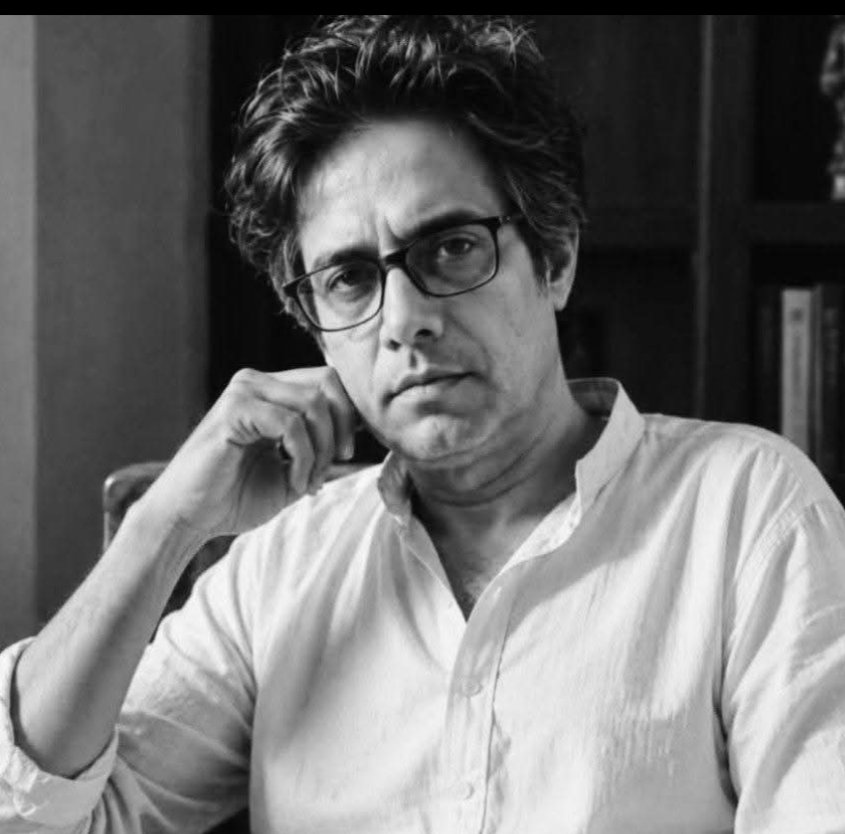
Subha Chakraborty is a Bengali poet, essayist, translator, editor, and collector of folk songs based in West Bengal, India. He writes poetry, short stories, and essays in Bengali, English, and Hindi, and translates Urdu and world literature into Bengali. His literary interests bring together Rabindranath Tagore and Mirza Ghalib; he studies their works and translates Ghalib’s letters and selections from his Diwan.
His poetry is marked by brevity, evocative imagery, ambiguity, and philosophical depth. His books include Tomar Srishtir Pathe, on Rabindranath Tagore, and Chhonder Bandhone Mukti. He has also published books of literary interviews and song collections. He travels through villages to collect folk songs, preserving the oral traditions of rural Bengal.
Chakraborty edits POEM, a print and online poetry magazine; Bengal Letters, an online literary magazine published in English and Hindi; and Dhusar Shohor, a Bengali print literary magazine. Through his writing, translation, and editorial work, he seeks to build bridges between languages, literary traditions, and cultures.

