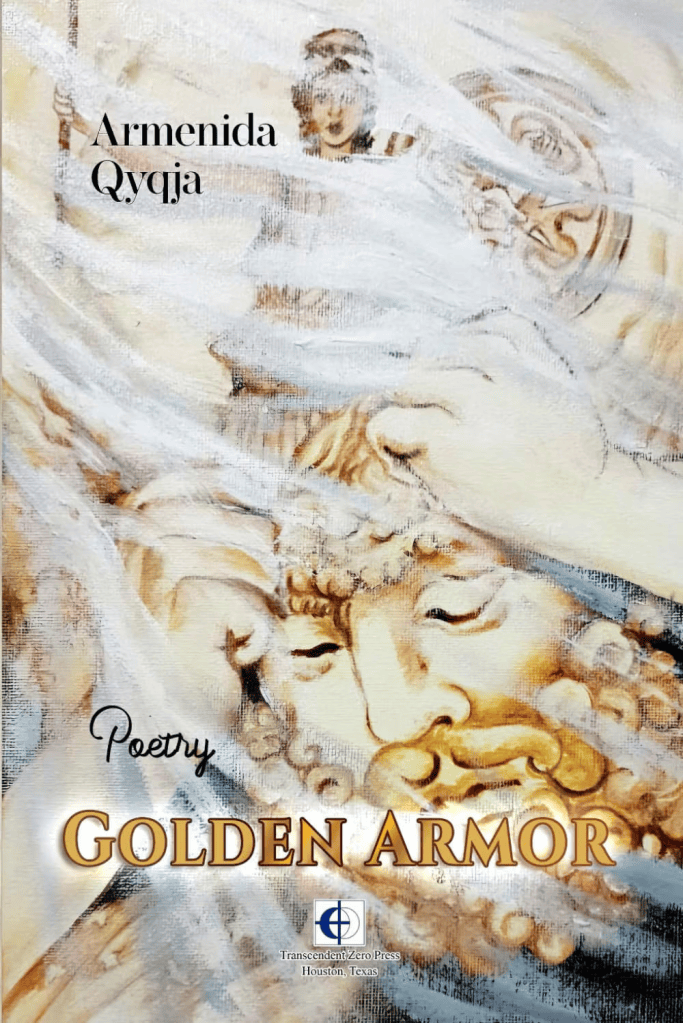
Golden Armor placed as da Vinci Eye Finalist in the 2026 Eric Hoffer Award
Pages: 111 pages
Category: Poetry / Women Authors
Price: $14 USD
Description: In Armenida Qyqja’s Golden Armor, we find poems of lyric exile commingled with those of war and witness—love poems to the beloved other, to a lost nation, to the speaker’s soul—all conceived in refutation of “the unsatiated hunger of silence.” This collection, originally written in Qyqja’s native Albanian and translated into English by the poet herself, is one woman’s grappling with the desperation and suffering of the refugee, in conversation with a relentless hope. Underpinned by both her strength and her compassion, these poems offer us as readers, not helplessness in the face of the world’s brutality, but the transcendence of the human spirit.
—Robin Davidson
Houston Poet Laureate (2015-2017)
& author of Mrs. Schmetterling
Armenida Qyqja’s poetry is filled with a painful urgency and quiet resistance, she excels at compressing existential reflection into tense rhythms, weaving together emotion and philosophical inquiry, navigating themes of personal trauma and collective struggle, and the Sisyphus-like search for meaning in an chaotic world.
—Ma Yongbo, Ph.D
representative of Chinese avant-garde poetry,
and a leading scholar in Anglo-American poetry
With a voice as taut and tensile as a bridge-cable, Armenida Qyqja dares to speak the simplest declaratives about those fearful complexities loneliness, “longingness,” living in times of war, repression, and genocide—not to mention the greatest complexity of all (and the hardest one to write about simply and clearly): one human heart’s love for another. Don’t mistake Qyqja’s directness, or her evocation of minutiae like holding hands or listening to the rain, for anything like reductive, easy thinking. This is the real stuff!
—Ryan Guth
author of Home Truths and Body and Soul
The entire trajectory of the words in the book replays the inner voice of the human, attacked by the destructive nature of existence exposed through wars, hatred, emptiness, absurdity, and the fatality of life. Nevertheless, the author does not kneel to all these challenges stipulated by life’s nature but stands up to overcome them all through longing for the voice of love and survival, as the mythological Greek king Sisyphus stands against fate through his relentless attempts admired throughout the centuries.
—Inga Zhghenti
Professor of English at DeVry University and Fulbright scholar
Expectations are painful. Deeply disturbing the soul of origin. Knowing that it will not meet the final ultimatum of seeing itself, it keeps helplessly seeking for the invisible tail of the truth. And keeps spinning trying to catch it. It never will.
Although, authoress keeps trying to ask for the catch 22, “feeling lucky” or not, she is just a reflection of the being that died already in somebody else’s soul. Lovable. Author’s war within is the war of all of us, human beings who cannot take it anymore. Why? Civilization is dying and this is just a cry of the thirsty one in a desert who will not see even a mirage.
She is a candle, but cannot be burned out. Yes, imagine a candle that cannot be burned out. It’s her within the poems. Strong, determined and truthful.
She is not afraid of Big Brother. Even. Why should she be? Because, destiny is written within the DNA, so everybody dies. Nevertheless, poems stay.
Seeking and expecting. Expecting and hoping. Hoping and waiting. That is the inner circle of her poetic soul. Knowing that the outcome will not be that one she is expecting. Does not matter. Because she teaches us. Above all.
Finally, this book of poetry is like a geyser. Whenever you think you have read everything, a new spark occurs. Like a human geyser. Then dies. And is born again through dying. Like all of us. After all.
—Review by Prof. Dr. & Dr. Honoris Causa Sabahudin Hadzialic
Bugojno, Bosnia and Herzegovina, Europe
Reviews
Lisa Rhodes-Ryabchich: “…passionate manuscript full of feministic candor, by an Albanian poet, showing readers how and what it means to stay alive mentally, physically, and emotionally during and after war. And how to survive the loneliness from longing and yearning for romantic love, from ones lover, vanquished by war, either real, or even possibly imagined, in a world full of continual catastrophic events, which Qyqja uses as a clever catalyst, to express her moral outrage regarding wars, human rights abuses, and most predominantly her country’s genocidal war, between the controlling Federal Republic of Yugoslavia and the Kosovo Albania separatist militia in Kosovo in 1999.”
Kashiana Singh: “Golden Armor is a collection of poems steeped in the tensions between intimacy and societal collapse. Its speaker moves through landscapes ravaged not only by war and political disillusionment, but by the quieter, enduring devastations of isolation, longing, and digital-era spiritual starvation.”
Inga Zhghenti:”These uncertainties and escalations are inseparable constituents of the book Golden Armor as it captures the most intimate and relatable journeys of searching the idea of “the self,” the unattainability and vulnerability of happiness, the unavoidability of fate, and the determined void and futility of the contemporary world dictated by consumerism, fabricated reality, and promulgated injustice, all juxtaposed with the concerns conditioned by the realization and recognition of life’s absurdity.”
Ars Notoria: This article has sample poems and the backstory for the book.
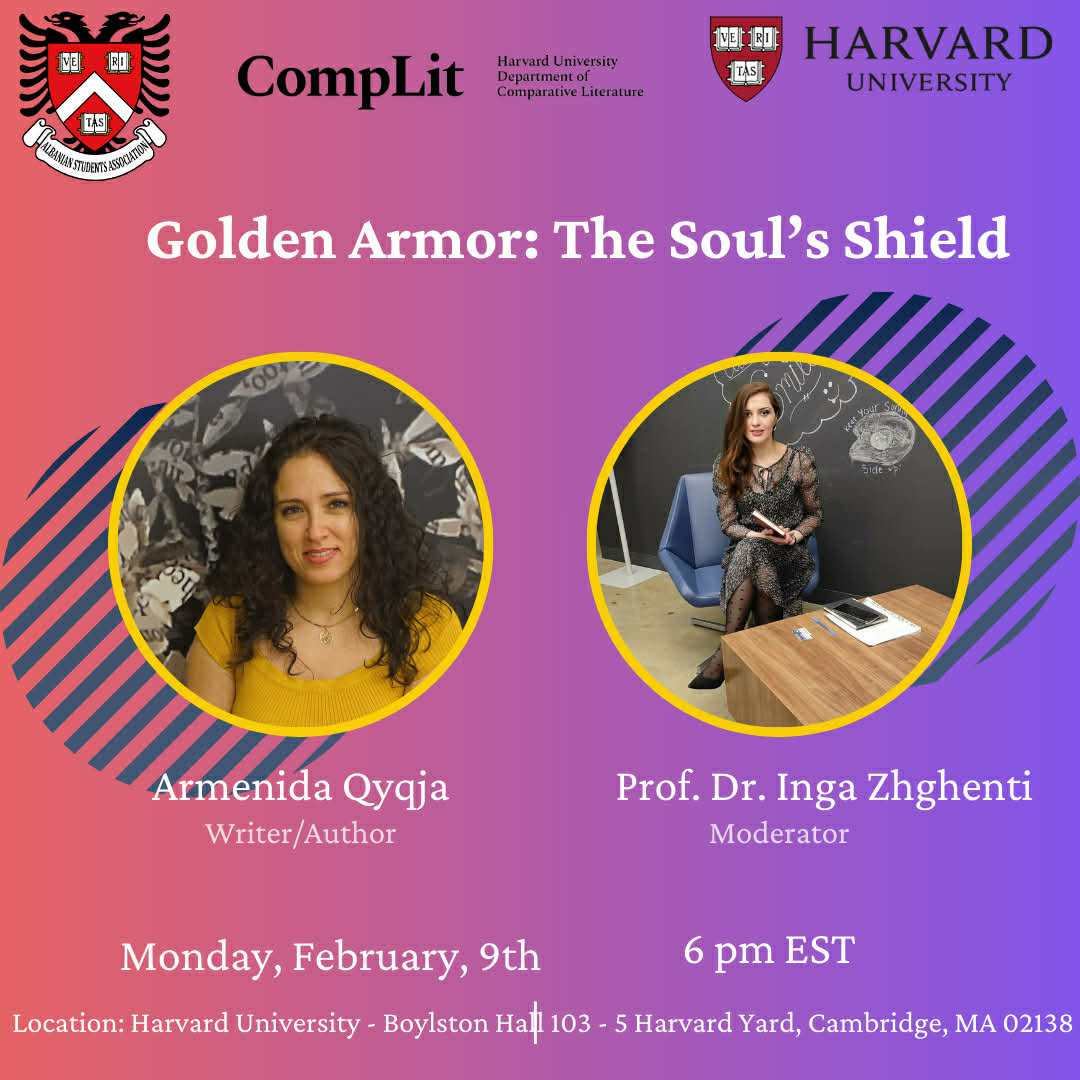
Watch the entire presentation The Soul’s Shield at Harvard University’s Comparative Literature Department
Book Trailer

Author bio: Armenida Qyqja was born in Tirana, Albania in 1977 and immigrated to Canada in 1995. She is the author of ten poetry books in Albanian language, two poetry collections in English and two books of short stories in Albanian. Currently she is preparing her new manuscript, Dawn’s Clarion.
LINKS FOR ORDERING AT AMAZON

