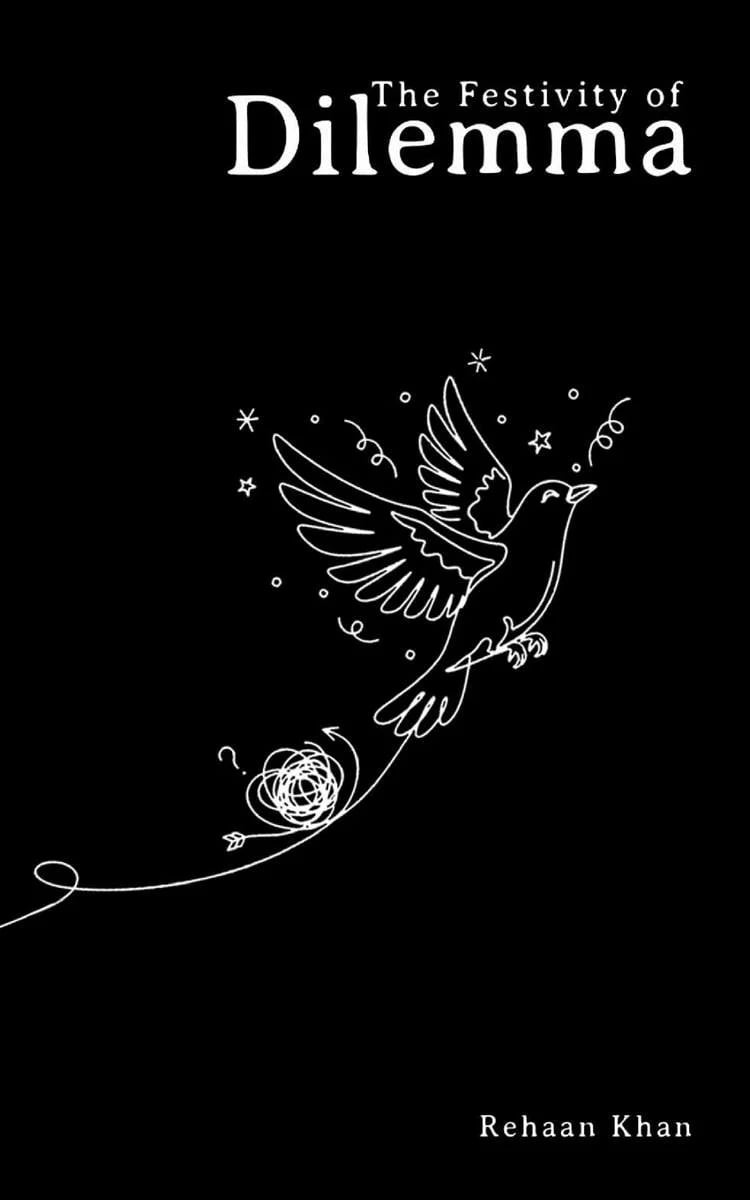
review of The Festivity of Dilemma by Rehaan Khan
What if the beauty that we value leads us to messy overindulgence that only fuels our bodily ego? When beauty destroys the one who is beautiful it is no longer part of care and is no longer a tool of appreciation. When this sort of crisis arises in terms of beauty, one better be an outsider—an asexual. Poet Rehaan Khan manages to capture this profound idea artistically without making it complex.
In this book of poems titled The Festivity of Dilemma Rehaan Khan sees the underbelly of aesthetics closely and examines it. This is a critique against society, and patriarchy where beauty is often tried to be plucked out, rather than allowed to be bloomed. He does this in a poem titled “Angels”.
I have chosen 8 poems from this book for writing this review. The poems I have selected are dynamic and impactful. They offer more than verses can offer—they have their own identity.
In the poem titled “Autism” the poet shows that high aspirations can beat any weakness. The child is not satisfied with toys and prototypes, he wants the real experience which is close to nature. This is breaking away from unreal experiences and I am sure if the child aspires to fulfill his dream nothing can stop him from knowing the real world. Autism is not the limit, which destroys the dreams and aspirations. The child hates the label which grown-ups have conferred to him as autistic. I quote three different stanzas from the poem Autism below:
Daddy, I want to catch the dragonflies That hovered over my grandma’s garden Not the dragonflies you bought for me Set in motion by a remote control.
So, my father,
I go hiding in dark corners of our home The place where my glowworms hide too When grown-up people visit our place So that I still look young
For unknown reasons, my father, Those grown-up ones say
I have autism! (Autism)
I truly respect the zeal with which poet Khan has processed the pain of a worker in the poem titled as “Oh My Sahib.” Sahib means the master. This master-slave dialectic is a moving piece in this collection. I truly felt the plight of the worker (his exploitation) while reading the poem.
Sahib, all these streets
Are those I constructed;
But look, I walk barefoot
That very house of yours Wherefrom you sent me out Was one I made too
Sahib, I realized it today—
That someone who fulfils others’ dreams and needs Finds that none of his dreams or desires
Is ever fulfilled. (Oh My Sahib)
In the poem titled Portrait, the poet draws a harrowing picture of finding meaning in life. I am using the word harrowing to describe the last line of this stanza. The image of armed men who have just read the Budhha’s sermons—this portrait of them is quite startling. The armed men felt the need to read the Buddha’s sermons, our image of what is to be done in the world reflects the change and that is our true portrait. The portrait is a true picture in the end—even King Ashoka renounced war and felt that peace was necessary. There are many portraits which we see, and we should be able to find our own portrait in the end. Portrait is a symbolic poem which is about finding a true reflection—we are all searching to be someone.
A few portray people who have just read Hitler’s words
And are lighting lamps of peace;
Others show armed men
Who have just read the Buddha’s sermons (Portrait)
The poem “Dashain” in this collection is about renewal and rejuvenation. The festival is dearly missed by the poet in the end and there is a sense of longing. It feels like in order to celebrate the festival the poetic persona has gone abroad to earn money and returned either with a box in hand or himself being a corpse in a box. The poet is a good grammarian in the sense how he plays with the word box. There is life and departure from life—a contrasting fusion of ideas. The oxymoron is at play and nothing is wrong with it. I quote two different stanzas together below:
Those wayside flowers Chrysanthemums, velvets and marigolds That had shed tears at my farewell
That cuckoo, danphe, munal and the crows That had mused of flying with me
Are also waiting for me, perhaps
Dear Dashain,
This waiting shall not go in vain I shall return
But I am myself unaware
If I shall return with a box in hand Or come back, packed inside a box. (Dashain)
The poem titled “Oh My Princess from a Distant Land” is one of the best creative piece by poet Rehaan Khan. There is an unmistaken simplicity in this poem. The poetic persona wishes to touch his beloved who is faraway.
At times,
I walk into the woods Pick some leaves
And write your name upon them. Meanwhile, wafts of wind blow And carry those leaves
To a distance place.
Oh my princess from that distant land, See if those flying leaves
Come and get stuck
On your window frame! (Oh My Princess from a Distant Land)
Again in the poem “The Red Box” poet Khan shows his ability to use language poetically. The Sindoor in Red Box symbolizes the conjugal bond of marriage, and that is transformed to a casket of death. Some misfortune has befallen.
He had brought a small box filled with vermillion For his wife
Though the wife often said — “You are my sindoor, sweetheart!”
The large box perhaps overheard this— It itself emerged as a sindoor cask
One fateful day At the airport. (The Red Box)
How fate never leaves us and how our life is charted out is a mystery, and the poet has heightened this idea by choosing bird as his object—the bird that is free in the sky from the hands of a bird-catcher. There are evil intentions lurking in a person, and the hands that help may be the hands that stifle.
This poetry collection left me with a sense of wonder—it is so well crafted and filled with deep introspection. It is so life like because varied aspects are touched. I wish poet Rehaan Khan a wonderful literary career. He is a successful poet with this book as a gift to humanity. Reading this book feels as if every aspect of life is so meticulously touched so that it always lingers in the memory. Highly recommended.

Bio: Sushant Thapa is a Nepalese poet. He has published Nine books of English poetry. His latest book is “The Walking Rebel Micropoems and Poems” published by Transcendent Zero Press. He has also published his book of flash fiction and short stories “The One Rupee Taker and Other Stories from Nepal” from Ukiyoto Publishing, recently. He has an MA in English Literature from Jawaharlal Nehru University in New Delhi, India. He teaches English Language and Literature to University level students in Biratnagar, Nepal. His poetry can be found published in Mad Swirl, Corporeal lit mag, Dissident Voice, Poetry Breakfast, Spillwords, Sacred Chickens Blog, The Beatnik Cowboy, etc. You can follow Sushant on his substack at substack.com/@sushantthapa

