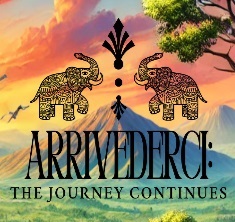
This robust folio of poetry is an heirloom collection of a life well lived. Its author, is far from at the end of her life but she’s one to embrace the journey thus far by pulling together her favorite insights and memories, some painful, some joyful, all real, and having gathered them, proffer their heart to the reader in a generous and shared love of experience. Experience being something we often mistake for scrolling on social media, wherein fact, experience must involve all the senses, as poetry necessarily bids us to do.
Time reverses its arrow, through the
Blue rune medium of faded word vehicles,
Starry Stonehenge wormholes,
Nocturnal posterns, (V And This is Why We Call Out Their Names).
This is the heart of Arrivederci: The Journey Continues by Amrita Valan. Her candor and simple appreciation for all things. There is no pretention here, there are no clever self-conscious methods to gain traction. Just the simplicity of a writer’s life, laid bare. Valan’s ability to be introspective at every juncture, revealing the hopefulness at the core of her heart, is the essence of her optimism and the contagious hope we inherit, reading her. She has lived a life where grief and joy have intermingled and found love is the only honest response. As she says in her introduction, even when the world; “appears to be a mad meaningless monotony. Love infuses these poems of my journey in the past through pain, loss, grief into the experience of wonder and hope.”
No doubt this is an ambitious feat, to believe people would wish to read so many facets of a single life. But Valan is not only prodigious and multi-layered in her ability to write on a wide variety of subjects, she is also able to put aside any self-consciousness and task herself with grafting those expressions without worrying about what others would think. The ability to be less self-conscious allows you to write without restraint and really say what you showed up to say, rather than an edited safe version. It is that honesty that brings a committed audience to the table. Universally recognized subjects, help strangers find solace, recognition or similarity in Valan’s work. She focuses on mental health, faith, physical sickness, the Pandemic, childhood memories, existential angst, friendship, parents, marriage, adversity, love, loss, culture and identity as well as hope, domestic abuse, experiential writing and ancestors. There’s literally so much here everyone is guaranteed to find a poem or more they can relate to.
This present-day war-torn ozone depleted globe,
Seeks blessings intuitively looks inward, to the
Unifying heritage of world myths. (Bending the Light).
The creation, self emerging fromArrivederci the Journey Continues, is decidedly lyrical and epic. Valan’s own journeys, may contribute to this singular yet mysteriously multifaceted sense of “I” that becomes universally “We.” The restlessness of Valan’s peregrinations is reflected in her writing, resulting in poems both magisterial and difficult diffractions of the singular self in almost ecstatically shifting encounters with universal concepts. She gathers your attention to the sudden sparkles that butterfly out of the seemingly mundane:
Truth, lies tears, sighs,
Steam up mirrors,
Misdirection, apathy,
Ignorance guides. (VI – Panic, A Visceral Avocation)
With social media gobbling depth; readers have little patience for fake questions, the kitsch of overcoming, sentimental celebrations of human triumph or faux self-determination in the guise of nature worship. Many of us just want something real. Scrolling online has become an empty metaphor for how we read online, the digital page become bottomless trough—but what of greater depth? Does the world have patience for it anymore? The language of writing is endlessly re-purposed for the medium that devalues it, the value desperate not for articles or poems or interviews, but ‘content.’ Therefore, even a heavy collection should find an audience, willing to resist the scroll. In the fermentation of writing, Valan considers the presence of deeper value in poetry. One akin to elegy at times, but more subliminal, an echo of what it is to be human. These fits and starts, reveal the warm imperfections of human craftsmanship. One that celebrates the beauty of beauty threatened by impermanenceand acknowledges the poem to be a liminal state, both evolving from, and devolving back toward its beginnings. We both say goodbye and hello, as we cycle through Valan’s steady compass:
I cannot dial my friends, not anymore.
I cannot talk about a thing. I’m impure.
Mind like a sieve. Inside I hear deathly quiet
Waterfalls sing. (Nemesis).
The flow and associations Valanevokes, looking at racism, violence and mental illness, is nuanced by a deeper understanding of how it threatens sense of safety, home and motherhood. This is personal; the poet herself is written in her distinct voice, evading a level of didacticism that people expect in ’political’ poems. The timeliness and the emotional chords Valan strikes, reflects the tradition of poets before her who speak out. Because of all this, Valan has become an archetypal solipsist-confessional poet whose consciousness of subjects like mental and physical illness, family violence and loss, creates mythic, and idiosyncratic work, produced over her lifetime, still current and influential.
The pole star shimmers and softly leads.
The southern cross with angel arms
Embraces us, against all harm
Harmony with the universe
Achieved through greatness,
Grandeur of undying love. (Immortal Bliss of the Hour)
What sets Arrivederci the Journey Continues, apart, is not the sheer number of poems that reflect and consider important aspects of life we should all ponder, but the conclusion reached by the author. The resilience of hopefulness. Alongside a mystical wonderment, Valan transports us through her world, and we emerge, believing it is possible to love and be loved. The wonderment of such a transfer of positive energy is the hard work of putting this together in such a way to evoke it, as Valan own words attest: “to catch a few falling stars of perhaps divine provenance, build my hopes and wishes on them, to pay tribute to my ancestors, to love and be loved, by my family and my friends who stood by me, and to gratefully wonder at the simple fact, that I am. That is the heart and essence of my poetry.”
There, all went well, or didn’t.
Whether or not, I hold you either way.
As a choice. (Love Me (K)not).
Valan’s writing epitomizes an epoch in Indian writing poetry in English, especially female, that is dominated by suburbanized meditations with an enduring sentiment and warm appeal to the kindnesses of living. That may sound rather dull, but consider the purposing of any writing, if not to evoke a union between reader and writer? And how better to achieve this than by sharing what may appear everyday but makes up the tapestry of a life?Memorable poetry transgresses the space between vulnerability and surrender, a steadypulse against the tides of forgetting. Valan’s lost self at times, is not delineated by an explicit anti-identity, butinstead a subtle reconfiguration of the subjective, where she returns to wholeness through despair, suffering and ultimately hopefulness. Her writing is an externalization process that projects images of the self onto the beautifully banal and then bewitches both with gorgeous renderings of spiritual and human evocativeness at its most poignant.
A day is lifetime of a single flower.
‘Carpe diem’ whispered the flower
‘Live for this day, this moment, this hour.’(Days are Flowers).
Valan is deliberately afflicted with the backbone of euphoria imbedded in the very consideration of poetry as a medium. Her translation is a poetry of blood, neighborhood, words and dreams that want more than anything to spill and scatter and lay bare — whatever she can say about the truth that lies between us all. Just as we used poetry to preserve our myths and stories before we had technology, we return to it like long lost observants, providing it speaks enough to our modern experience.
The rain fell on our skin
Which burnt
Tears trickled from eyes
That were stupefied
When Eves’ fingers
Tenderly wiped them away.
Thus,
Lustily
We fell into
Humanity and Love. (Fallen).
Valan detests the idea that anyone would simply want a false optic of some old, longed-for happiness. But, at the same time, her poems make a wistful music, even as the melodies are absorbed and transitory.Her knowledge of history and multiple subjects, leaves no room for tedium, but with such a long collection there’s the temptation to dive in and flick through. I’ve not read many collections where the author asks you to read in a sequence. There is a purpose to the requested discipline, some poems are sequential and have a story despite their separateness. Without that discipline we lose touch with the author’s intention and there’s something refreshing about a request from the author to read it the way she wants us to read it:
You may never leave.
A one-way ticket.
Your time?
Or mine?
Travel back with us
So we may travel onwards with you (Let Me Travel with You).
What is a poem other than a tantalizing glimpse at meaning dissolving? Even becoming a ceremonial experience of almost, that slips through our hands? An utterance’s ultimate inability to fully represent the mysterious source material of its existence, reveals many other layers of meanings, which ripple outward from speech in ways the speaker doesn’t always control. Not so with poetry. A honed poet will have multiple messages within one subject or a singular poem. In this collection, whilst we’re taken around the universe and back, there is a unifying message, it is both subtle and displayed in myriad voices. Ultimately Valan’s devotion to the love of writing and describing her world, is her alter and ours. Superseding the actor, it is the pique of truth throughout that stays firmly in the head and says I am here, are you here too?
In my goldfish bowl
Time’s trapped oceans.
Strange symphonies lilt
Mermaid days laid out
To dry like fishing nets. (Fishbowl of Dreams).
– Candice Louisa Daquin, Senior Editor Indie Blu(e) Publishing, Editor, Raw Earth Ink & Editor for Parcham Literary Magazine, Tint Journal and The Pine Cone Review.

