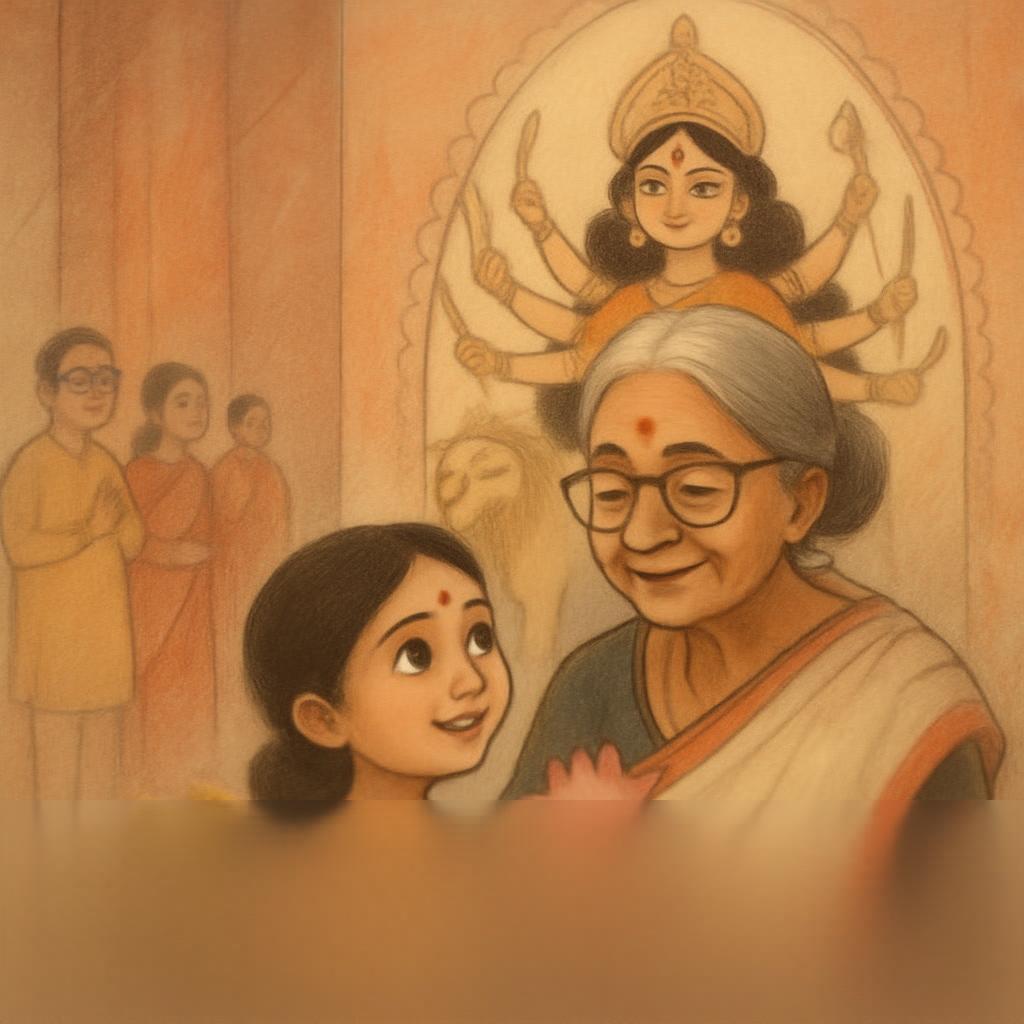
The autumn wind in London carried a strange scent that year—half mist, half memory. Anamika stood by the bay window of their Hampstead home, her silver hair tied in a neat bun, her eyes scanning the golden leaves swirling outside. Rudhi, her five-year-old granddaughter, tugged at her sari pallu.
“Deemama, when will Ma Durga come?”
Anamika smiled, her heart swelling with a joy she hadn’t felt since her days in Kolkata’s Ballygunge, where the puja pandals bloomed like lotus petals in the city’s soul. “She’s already on her way, shona,” she whispered, brushing Rudhi’s cheek.
Bijoy, now a retired professor with a poet’s heart, sat in the corner armchair, sipping his Darjeeling tea. He had just returned from the Bengali Café Coffee Stall near Ealing Broadway, where old friends from his Presidency College days gathered each year before Durga Puja. The café, with its mismatched chairs and Tagore posters, was their adda haven. The laughter, the debates, the shared memories of pujas past—it was their way of invoking Ma Durga before she arrived.This year, Bijoy and Anamika had flown in from Kolkata earlier than usual. Their son Deepak, a cardiologist at St. George’s, had insisted. “Ma, Baba, Rudhi keeps asking about you. And Radha’s school is organizing a Durga Puja exhibition. You must be here.”
Radha, their daughter-in-law, was a teacher at the London High School, where she taught literature with the grace of a dancer and the precision of a scholar. She had curated a special section on Shakti—the divine feminine—for her students, blending mythology with modern feminist thought.The Bengali locality in London had transformed into a miniature Kolkata. Dhakis had arrived from Howrah, their drums echoing through the chilly streets. A singer from Rabindra Sadan was rehearsing Agomoni songs in the community hall. The priest, flown in from Salt Lake, was preparing the rituals with meticulous care, his voice resonating with mantras that seemed to stitch time and space together.On Shashthi, the sixth day of the puja, Rudhi wore a red-bordered white saree, her tiny feet dancing to the beat of the dhak. Anamika watched her, tears glistening in her eyes. “She reminds me of you, Radha,” she said softly.
Radha smiled. “And of you, Ma. The circle continues.”
Bijoy stood near the idol, his eyes fixed on Ma Durga’s face. The artisans had sculpted her in Kumartuli before shipping her across oceans. Yet, she looked no less radiant here, her eyes fierce and compassionate, her ten arms holding the weapons of justice and love.
As the Pushpanjali began, Anamika closed her eyes. She remembered her childhood pujas in Shantiniketan, the scent of shiuli flowers, the rustle of silk saris, the songs of Agomoni echoing through the red earth. She remembered her first puja after marriage, holding Bijoy’s hand as they offered flowers together. And now, here she was, in London, offering flowers with her granddaughter.
“Ma Durga came,” she whispered.
Not just in the idol, not just in the rituals. She came in the laughter of old friends at the café, in the curious questions of schoolchildren learning about Shakti, in the dhak beats that defied geography, in the eyes of Rudhi who saw her Deemama as a goddess of stories and love.On Dashami, the day of immersion, the community gathered near the Thames. The idol was symbolic, the immersion metaphorical. Bijoy recited a poem he had written:
She came not by boat, nor cloud, nor flame, She came in hearts that called her name. From Kolkata’s lanes to London’s skies, Ma Durga walks where memory lies.
As the crowd chanted “Asche bochor abar hobe”—next year, she will come again—Anamika held Rudhi close. The little girl looked up and asked, “Will Ma Durga come to our house too?”
Anamika kissed her forehead. “She already has, shona. She lives in every story we tell, every song we sing, every love we share.”And in that moment, beneath the grey London sky, with the Thames flowing like time itself, Ma Durga smiled.
The writer of the story International Tagore Awardee Dr. Ratan Bhattacharjee is a Former Affiliate Faculty of Virginia Commonwealth University USA. Email:profratanbhattacharjee@gmail.com
 Transcendent Zero Press